
 Other versions by this Author
Organizing in the Digital Age draws on a process-oriented perspective to understand the pervasiveness of digitalization in organizations, and contemporary society. Ongoing and multiple crises, whether it be the pandemic, the economy, or climate change, have magnified the importance of digital technologies in processes of organizing and accelerated the role of digital transformation in work-life.
The central themes underpinning the chapters in this book concern the becoming of digital work, the conceptualization of agency in digital work, and the role of temporality in contemporary organizing. The increasing entanglement of digital technologies and work (accelerated through the Covid-19 pandemic) have fuelled interest in the need for understanding digital work happening at scale, while also examining and exposing inequalities. The concern with the role of agency in digital work reaches new heights when we consider the rapid and pervasive development and implementation of Artificial Intelligence (AI), and algorithmic control, and raises concerns about the ethical and moral dimension of agency. Methodologically, the book explores the use of digital trace data as a resource in the study of organizing processes. While digital traces offer unprecedented access to temporally evolving activity, they are nevertheless limited in their ability to represent phenomena. In essence, 'processual shadows' visible from digital data traces may be difficult to interpret without in-person observational data such as ethnography. Theoretical approaches around performativity are discussed in terms of the impact (or not) of innovative digital technologies, such as blockchain in organizations, while routine dynamics and pragmatism are drawn on in providing a processual understanding of the why and how of IT computer workarounds within organizational work practices.
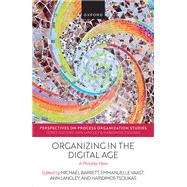
Organizing in the Digital Age A Process View
by Tsoukas, Haridimos; Langley, Ann; Barrett, Michael; Vaast, EmmanuelleFormat: Hardcover
Pub. Date: 2024-07-25
Publisher(s): Oxford University Press
List Price: $132.53
Buy New
Usually Ships in 5-7 Business Days
$126.22
Rent Textbook
Select for Price
Digital
$89.99*
Used Textbook
We're Sorry
Sold Out
How Marketplace Works:
- This item is offered by an independent seller and not shipped from our warehouse
- Item details like edition and cover design may differ from our description; see seller's comments before ordering.
- Sellers much confirm and ship within two business days; otherwise, the order will be cancelled and refunded.
- Marketplace purchases cannot be returned to eCampus.com. Contact the seller directly for inquiries; if no response within two days, contact customer service.
- Additional shipping costs apply to Marketplace purchases. Review shipping costs at checkout.
Summary
Table of Contents
1. Organizing in the Digital Age: A Process View: An Introduction, Michael Barrett, Emma Vaast, Ann Langley, Haridimos Tsoukas2. Creation Beyond Creativity: From The Novelty of Ends to the Renewal of Life, Tim Ingold3. On Thinking Movement: Theorizing Flows of Organizing in a Digital Age, Lotta Hultin, Lucas Introna, Magnus Mähring4. Algorithmic Automation of Knowledge Work - A Sketch for Exploring the Becoming of Knowledge Work, Dubravka Cecez-Kecmanovic5. Utopias as Borderlands: Reconceptualizing Post-pandemic Future(s). An Image: Post-pandemic GnosislÃve, Dirk S. Hovorka6. Physics or archaeology? Process organisation studies in the age of data abundance, Matthew Jones7. Pentland, B., Wolf, J.R., Xie, Y., Kim, I., Frank, K., Pentland, A. Processual Shadows: What Can We See with Digital Trace Data?, Brian T. Pentland, Julie Ryan Wolf, Yunna Xie, Inkyu Kim, Kenneth Frank, Alice Pentland8. Collaborating Using Digital Technologies: The Role of Generative Memory, Raghu Garud, Arun Kumaraswamy, Philipp Tuertscher9. Blockchain and the Performativity of Emerging Technology Theories, Moritz J. Kleinaltenkamp, Shaz Ansari10. Azad, B., King, N. Computer Workarounds or Expediting Work?, Bijan Azad, Nelson King
An electronic version of this book is available through VitalSource.
This book is viewable on PC, Mac, iPhone, iPad, iPod Touch, and most smartphones.
By purchasing, you will be able to view this book online, as well as download it, for the chosen number of days.
Digital License
You are licensing a digital product for a set duration. Durations are set forth in the product description, with "Lifetime" typically meaning five (5) years of online access and permanent download to a supported device. All licenses are non-transferable.
More details can be found here.
A downloadable version of this book is available through the eCampus Reader or compatible Adobe readers.
Applications are available on iOS, Android, PC, Mac, and Windows Mobile platforms.
Please view the compatibility matrix prior to purchase.