
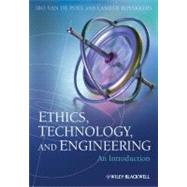
Ethics, Technology, and Engineering An Introduction
by van de Poel, Ibo; Royakkers, LamberEdition: 1st
Format: Paperback
Pub. Date: 2011-05-02
Publisher(s): Wiley-Blackwell
 Other versions by this Author
List Price: $77.15
Buy New
Usually Ships in 8 - 10 Business Days.
$73.48
Buy Used
Usually Ships in 24-48 Hours
$53.56
Rent Textbook
Select for Price
Rent Digital
$136.80*
How Marketplace Works:
- This item is offered by an independent seller and not shipped from our warehouse
- Item details like edition and cover design may differ from our description; see seller's comments before ordering.
- Sellers much confirm and ship within two business days; otherwise, the order will be cancelled and refunded.
- Marketplace purchases cannot be returned to eCampus.com. Contact the seller directly for inquiries; if no response within two days, contact customer service.
- Additional shipping costs apply to Marketplace purchases. Review shipping costs at checkout.
Summary
Featuring a wide range of international case studies, Ethics, Technology, and Engineering presents a unique and systematic approach for engineering students to deal with the ethical issues that are increasingly inherent in engineering practice. Utilizes a systematic approach to ethical case analysis -- the ethical cycle -- which features a wide range of real-life international case studies including the Challenger Space Shuttle, the Herald of Free Enterprise and biofuels. Covers a broad range of topics, including ethics in design, risks, responsibility, sustainability, and emerging technologies Can be used in conjunction with the online ethics tool Agora ( http://www.ethicsandtechnology.com) Provides engineering students with a clear introduction to the main ethical theories Includes an extensive glossary with key terms
Author Biography
Ibo van de Poel is Associate Professor in Ethics and Technology at Delft University of Technology. He is an associate editor of the Handbook of Philosophy of Technology and the Engineering Sciences (2009) and co-editor of Philosophy and Engineering (2010).
Lambèr Royakkers is Associate Professor in Ethics of Technology at Eindhoven University of Technology, and Associate Professor in Military Ethics at Netherlands Defense Academy. He is also Project Leader of the research programme Moral Fitness of Military Personnel in a Networked Environment, sponsored by the Netherlands Organization for Scientific Research.
Table of Contents
Acknowledgments.
Introduction.
1 The Responsibilities of Engineers.
1.1 Introduction.
1.2 Responsibility.
1.3 Passive Responsibility.
1.4 Active Responsibility and the Ideals of Engineers.
1.5 Engineers versus Managers.
1.6 The Social Context of Technological Development.
1.7 Chapter Summary.
2 Codes of Conduct.
2.1 Introduction.
2.2 Codes of Conduct.
2.3 Possibilities and Limitations of Codes of Conduct.
2.4 Codes of Conduct in an International Context.
2.5 Chapter Summary.
3 Normative Ethics.
3.1 Introduction.
3.2 Ethics and Morality.
3.3 Descriptive and Normative Judgments.
3.4 Points of Departure: Values, Norms, and Virtues.
3.5 Relativism and Absolutism.
3.6 Ethical Theories.
3.7 Utilitarianism.
3.8 Kantian Theory.
3.9 Virtue Ethics.
3.10 Care Ethics.
3.11 Applied Ethics.
3.12 Chapter Summary.
4 Normative Argumentation.
4.1 Introduction.
4.2 Valid Arguments.
4.3 Deductive and Non-Deductive Arguments.
4.4 Arguments in Ethical Theories.
4.5 Fallacies.
4.6 Chapter Summary.
5 The Ethical Cycle.
5.1 Introduction.
5.2 Ill-Structured Problems.
5.3 The Ethical Cycle.
5.4 An Example.
5.5 Collective Moral Deliberation and Social Arrangements.
5.6 Chapter Summary.
6 Ethical Questions in the Design of Technology.
6.1 Introduction.
6.2 Ethical Issues During the Design Process.
6.3 Trade-offs and Value Conflicts.
6.4 Regulatory Frameworks: Normal and Radical Design.
6.5 Chapter Summary.
7 Designing Morality (Peter-Paul Verbeek).
7.1 Introduction.
7.2 Ethics as a Matter of Things.
7.3 Technological Mediation.
7.4 Moralizing Technology.
7.5 Designing Mediations.
7.6 Chapter Summary.
8 Ethical Aspects of Technical Risks.
8.1 Introduction.
8.2 Definitions of Central Terms.
8.3 The Engineer's Responsibility for Safety.
8.4 Risk Assessment.
8.5 When are Risks Acceptable?
8.6 Risk Communication.
8.7 Dealing with Uncertainty and Ignorance.
8.8 Chapter Summary.
9 The Distribution of Responsibility in Engineering.
9.1 Introduction.
9.2 The Problem of Many Hands.
9.3 Responsibility and the Law.
9.4 Responsibility in Organizations.
9.5 Responsibility Distributions and Technological Designs.
9.6 Chapter Summary.
10 Sustainability, Ethics, and Technology (Michiel Brumsen).
10.1 Introduction.
10.2 Environmental Ethics?
10.3 Environmental Problems.
10.4 Sustainable Development.
10.5 Can a Sustainable Society be Realized?
10.6 Engineers and Sustainability.
10.7 Chapter Summary.
Study Questions.
Discussion Questions.
Appendix I: Engineering Qualifications and Organizations in a Number of Countries.
Appendix II: NSPE Code of Ethics for Engineers.
Appendix III: FEANI Position Paper on Code of Conduct: Ethics and Conduct of Professional Engineers.
Appendix IV: Shell Code of Conduct.
Appendix V: DSM Values and Whistle Blowing Policy.
Glossary.
References.
Index of Cases.
Index.
An electronic version of this book is available through VitalSource.
This book is viewable on PC, Mac, iPhone, iPad, iPod Touch, and most smartphones.
By purchasing, you will be able to view this book online, as well as download it, for the chosen number of days.
Digital License
You are licensing a digital product for a set duration. Durations are set forth in the product description, with "Lifetime" typically meaning five (5) years of online access and permanent download to a supported device. All licenses are non-transferable.
More details can be found here.
A downloadable version of this book is available through the eCampus Reader or compatible Adobe readers.
Applications are available on iOS, Android, PC, Mac, and Windows Mobile platforms.
Please view the compatibility matrix prior to purchase.